Anish Kasam
← Back to all postsThe State of Tech
Goodbye, $165,000 Tech Jobs. Student Coders Seek Work at Chipotle, a recent piece by the New York Times, covers the absolute shitshow that the tech job market has become. It’s a decent read, but I think it paints an incomplete picture; the article, like many others, attribute the bad job market to AI, but I think it’s a lot more nuanced than that. In reality, it’s a perfect storm of overhiring, oversaturation, and outsourcing — the three O’s (look at me using em dashes), or more poetically, the three horsemen of the tech apocalypse.
Overhiring
The pandemic inherently changed our society; industries that were fundamentally in-person, like healthcare and education, were forced to shift to a remote setting, basically overnight. To support these industries, software and infrastructure needed to be developed quickly.
Additionally, to prevent an economic collapse, the government slashed interest rates. This meant that tech companies needed engineers and also had the money to hire them, resulting in one of the biggest hiring booms in modern history.
In fact, the demand for software engineers, data scientists, and cloud developers was so high that some people were able to land $100k+ job offers after a three month bootcamp. Looking back, it’s almost unfathomable. Nowadays, we have graduates from the best schools in the country unable to find jobs even after 4+ years in college.
But, after the world started transitioning back to normalcy, the hiring frenzy also died down. Hiring standards rebounded, interest rates increased, and companies realized they had far more engineers than they needed. Cue the layoffs.
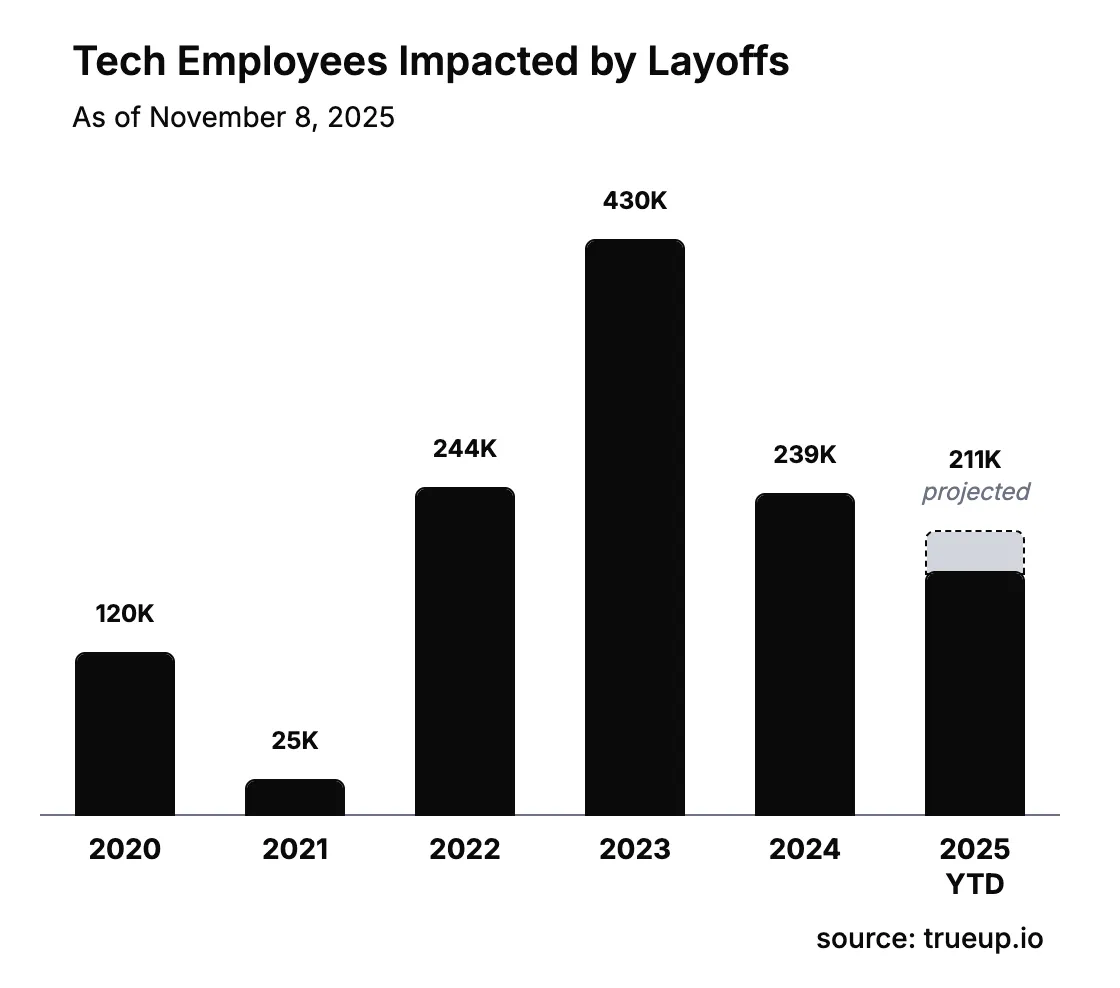
Since 2022, well over 1 million tech employees have been laid off, with companies like Amazon, Google, Meta, and Microsoft leading the charge. There’s been a fundamental shift, companies are focused on being lean and efficient: smaller teams, more ownership, and higher expectations for engineers.
Oversaturation
During the pandemic, a lot of high school students (myself included) were mindlessly scrolling through TikTok or Instagram. One of the most common genres of videos was “Day in the Life of a Software Engineer at [insert FAANG+ company].” These videos glorified the lifestyle: remote/hybrid work and life changing salaries, all while putting in minimal effort.
Another common type of video was the success stories of those who were able to retire early or achieve financial freedom. One of the most notable people making this style of video was Frank Niu, a former Staff Engineer at Netflix, who was able to retire at 30.
These narratives permeated throughout society. It seemed like everywhere you looked, people were telling you to code. They claimed that it was the job of the future, that it’d come with job security, and set you up financially.
Naturally, people flocked. At UCSD, it seems like nearly everyone is majoring or minoring in computer science, data science, machine learning, or some other adjacent field.
The worst part is, many of the perks that were luring people in are slowly disappearing. Return to office mandates are back, many companies are now requiring at least 3 days in the office, Amazon’s 5 day requirement being the most stringent. On top of that, widespread layoffs have eroded job security while increasing engineers’ workloads, with 50–60 hour weeks at FAANG+ companies becoming the norm. Startups aren’t any better, many have adopted the brutal “9-9-6” schedule; 9 am to 9 pm, six days a week.
Back then, everyone was getting hired, so there were no cautionary tales, no stories of failure to warn the masses.
Outsourcing
For decades, the US was so far ahead of every other country, that outsourcing was reserved for mostly menial work. However, other countries have significantly caught up, especially India, where there’s a huge engineering culture. Why would a company pay someone $160k when they can hire someone for a quarter of that and still get 80–100% of the output?
There aren’t many downsides to outsourcing either. Firstly, the infrastructure for supporting remote work was already built during the pandemic. Also, many cite the time zone difference, but even that can work in employers’ favor. With teams across the world, companies get continuous development/support. Alternatively, if they want to avoid the time zone issue altogether, there are countries like Brazil that line up almost perfectly with US hours.
Unemployment
One of the most cited statistics is unemployment by degree. Computer science majors now sit in the top ten, hovering around 6–7%. That doesn’t sound terrible at first glance, but it’s also a bit misleading. Underemployment is also important to consider, and that number is closer to 16–17%. In other words, nearly a quarter of students graduating with a CS degree aren’t using it in a meaningful way. That’s concerning for a major that’s this rigorous, and it’s only getting worse.
Honestly, what’s even more frightening is that these numbers are probably biased low. Anecdotally, I know tons of people who weren’t able to find jobs that are delaying their graduation or pursuing graduate school, so that they have more time to potentially land an internship. Now, this is detrimental for multiple reasons: it’s increasing the number of people applying for internships, students are incurring more debt/costs by staying in school, and it’s raising the hiring bar. If two people have similar experience, why not hire the one with the advanced degree, especially if you can pay them the same salary.
The New Reality
Graduating with a degree from an elite university is no longer sufficient; the bar continues to get higher and higher. From personal experience and speaking to peers, it’s standard to submit hundreds, if not a thousand applications for a single internship cycle, and you’ll be lucky to land a few interviews.
Coasting through college is no longer an option, companies expect you to have multiple relevant experiences (teaching assistantships, research labs, etc.) just to land an internship. The bar is even higher for full time jobs, having an internship is almost a necessity.
LinkedInfluencers & Bad Advice
This is a bit of an aside, but important to mention. With so many people struggling to find a job, some are trying to capitalize on that desperation. Every time I scroll through LinkedIn, I see posts telling people to comment some keyword to receive a spreadsheet with job postings, a cold email template, or some other “life changing” resource. Half (honestly 90%) of these posts are engagement bait disguised as generosity.
On top of that, I think there’s a lot of bad advice out there. People who broke into tech during the “golden age” like to think they’d make it in today’s market too. That may or may not be true, but either way they often share advice that simply doesn’t work anymore.
Take cold emailing for example; this is a LinkedIn staple. People love to talk about how they landed their first job from a cold email. Firstly, there’s an insane amount of survivorship bias associated with this (you only hear about the successes). Beyond that, the reason the email worked wasn’t due to its content, it came from the fact that nobody else was doing it. Every recruiter, CEO, and hiring manager is probably getting spammed with cold emails right now, and is definitely ignoring them.
This logic applies to nearly every tip, trick, or hack that is shared: LinkedIn optimization, personal websites, AI-generated cover letters. Once everyone does it, it loses its value. Sure, you may find the next “shortcut” if you’re lucky, but the better approach is to optimize for the job that you are actually going to end up doing. Truly learn the fundamentals, gain experience by actually writing code, and build your network.
The Future
Everyone says that tech hiring runs in cycles, and that eventually “things will get better.” But, who really knows? We live in unprecedented times, and patterns only hold until they don’t.